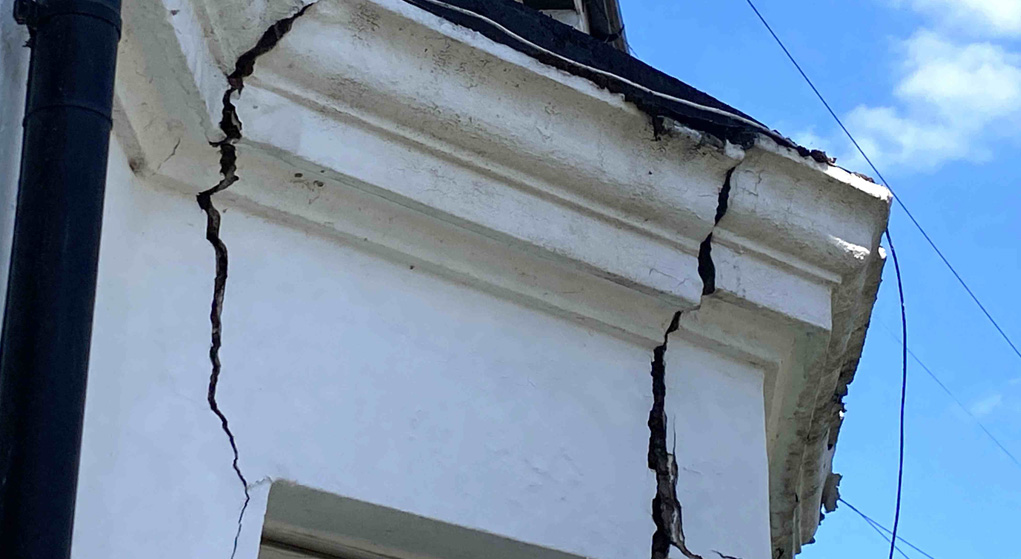
Following one of the driest summers on record, we thought it would be useful to share some of the questions we have been asked most frequently by clients about subsidence and cracking, together with the reassurance and practical advice we are able to provide.
In most cases, matters are not as serious – or as expensive to resolve – as homeowners initially fear.
SERL (Structural Engineers Reports Limited) has received a record number of enquiries during the dry summer of 2026 relating to possible subsidence and cracking in properties across South West London.
By way of a brief explanation, much of the local housing stock comprises of period properties dating from around 1880 to the 1930s. Many have relatively shallow foundations resting on London Clay. South West London is also particularly green, with numerous mature trees. These factors can combine to create conditions where seasonal ground movement and subsidence are more likely.
Cracks naturally cause concern for all sorts of reasons. In our 40 years of dealing with enquiries from homeowners, we find that the most common concerns are:
a) The property might become unsafe if cracks grow rapidly.
b) Repairs might be expensive and disruptive internally.
c) The value of the property might be compromised by cracking.
d) Insurance premiums might increase or insurance cover might be withdrawn.
e) Cracking might compromise the buying or selling process.
f) Doors might stick or become difficult to open, while numerous small cracks appear.
Here are some brief answers to these concerns.
a) The property might become unsafe if cracks grow rapidly
Cracks occur when one part of a property moves or settles slightly relative to an adjoining area. This will often affect very localised parts of a building, such as an external wall, bay window or porch, rather than the house as a whole. This is partly because external walls and projections such as bay windows are often closest to trees and areas of garden where the soil can dry out during periods of drought.
Small cracks of up to around 3mm are generally of little structural consequence and can often be repaired relatively easily from time to time. And 3mm is actually quite a wide crack! Most cracks that alarm homeowners are much smaller – often hairline cracks or around a millimetre wide.
These minor cracks can sometimes be dealt with using simple repairs such as resin injection, depending on their cause and location. The cost can be modest. It is rather like carrying out occasional minor repairs to the bodywork of a car: the existence of a small crack does not, in itself, mean that the property is unsafe.
The more important issue is understanding why the crack has occurred and whether there is any reason to believe that relatively minor cracking could develop further. That is a subject for another article.
b) Repairs might be expensive and disruptive internally
Many crack repairs are surprisingly straightforward and relatively inexpensive.
Depending on the extent and cause of the cracking, repairs can range from a few hundred pounds for an individual crack of moderate length to a few thousand pounds where there is more extensive cracking. In our experience, this is often a long way from the tens of thousands of pounds that homeowners may fear. Where appropriate, repairs can often be undertaken externally, minimising disruption and damage to the interior of the property.
On occasions, cracks may benefit from additional reinforcement using steel Helibar rods. However, this is not always necessary. In some cases, for example, bay windows or other projecting structures may benefit from being tied back into the main body of the house.
The appropriate repair will always depend on the cause, location and severity of the cracking.
c) The value of a home might be compromised by cracking
Cracking can be an emotive subject and can sometimes create concerns that are disproportionate to the actual problem.
Buyers, surveyors and lenders can understandably worry that visible cracks may indicate a more significant structural issue. This is where the experience of a structural engineer can be particularly valuable.
Our role is not simply to identify cracking, but to understand the engineering behind it and explain the practical implications in straightforward terms – including what the cracking does and does not mean.
It is very rare for a house that we survey, and which contains moderate cracking, to require major expenditure. In many cases, once the cause and appropriate remedial work have been established, a property sale can proceed with all parties aware of the relevant costs and risks.
d) Insurance premiums might increase or insurance might be withdrawn
The approach taken by insurance companies when homeowners notify them about cracking or a possible subsidence claim can vary considerably. Some insurers are very helpful, while others may increase premiums or policy excesses, or in some circumstances withdraw cover. Understandably, this can cause considerable anxiety for both homeowners and people trying to buy or sell a property.
In general, we advise clients to think carefully before making an insurance claim where the likely repair costs are relatively modest, assuming they are able to fund the work themselves. There may, however, be an obligation under the terms of an insurance policy to notify the insurer of certain circumstances, so homeowners should always check their policy carefully before deciding what to do.
For example, if a policy has a £1,500 excess, some minor cracking repairs may cost less than this amount and could potentially be dealt with as part of normal property maintenance rather than through an insurance claim.
e) Cracking might compromise buying or selling
Ideally, a property being put on the market would be presented in good condition, with obvious defects dealt with where possible. However, it is important that vendors are transparent about known problems. Attempting to disguise cracks with recent redecoration is rarely helpful, as an experienced surveyor will often spot signs of previous movement.
A better approach is to obtain professional advice and, where appropriate, share that advice openly with prospective buyers.
Dealing with a structural issue at an early stage can make the selling process considerably less stressful. It is much better to understand and explain an issue before a buyer’s survey raises concerns, when time pressures, renegotiations and the risk of a property chain collapsing can make matters considerably more difficult.
A discerning buyer will normally commission an RICS Level 2 or Level 3 survey to understand the overall condition of a property. An experienced surveyor will usually be able to provide preliminary advice on structural matters and will know when it is appropriate to refer a buyer to a Chartered Structural Engineer for more detailed investigation.
A lender’s valuation surveyor is, of course, primarily concerned with the interests of the lender. If they identify something that gives them cause for concern, they may request a specialist structural report before the mortgage can proceed.
A clear and properly prepared structural engineer’s report can often provide the reassurance required by homeowners, buyers and lenders, allowing transactions to proceed where the underlying issue is understood and manageable.
f) Doors stick, won’t open and numerous small cracks appear
Given all the concerns discussed above, it is understandable that homeowners become worried when doors suddenly start sticking and several small cracks appear around the property. In many cases, however, we can provide reassurance that the situation is not as serious as it first appears.
All buildings move to some degree. Property materials respond to changes in temperature, moisture levels, seasons and climate. Older properties in particular can experience small amounts of seasonal movement. Small cracks can certainly be a nuisance and may be unsightly, but they do not automatically indicate a serious structural problem.
The important thing is to establish the cause of the movement and understand whether it is likely to remain seasonal and manageable or whether further investigation or remedial work is required.
Is seasonal movement becoming the new normal?
With increasingly dry summers and our changing climate, those of us living in older houses built on clay soils may have to become more accustomed to minor seasonal movement.
It is possible that insurers will increasingly respond by raising subsidence excesses, leaving homeowners to deal with routine seasonal movement as part of their normal redecoration, maintenance and repair budgets. For now, the important message is not to panic when you see a crack.
Cracking does not automatically mean subsidence, and subsidence does not automatically mean an unsafe house or a huge repair bill. Understanding the cause is the key to understanding the risk – and in many cases, professional advice can provide considerably more reassurance than homeowners initially expect.